DeepL Optimizes Global Hybrid Network Maintenance Using AWS Cloud WAN and Direct Connect Integration

DeepL, a prominent Language AI enterprise specializing in written and real-time voice translation products used by more than 200,000 corporate teams globally, has detailed its advanced strategy for managing hybrid network infrastructure. Operating a vast digital footprint that spans multiple Amazon Web Services (AWS) Regions across Europe, North America, and Asia—coupled with hybrid connectivity back to two primary European data centers—the company has implemented a sophisticated routing mechanism to handle planned maintenance windows without causing widespread disruptions or unexpected latency spikes.
The architectural framework relies on AWS Cloud WAN and a natively attached Direct Connect gateway to execute targeted traffic engineering. By leveraging strategic Border Gateway Protocol (BGP) attributes, specifically an Autonomous System Path (AS_PATH) prepend, DeepL’s engineering team can seamlessly drain traffic from a single designated Direct Connect link during maintenance while ensuring that all other global Regions maintain their optimized, localized egress routes.
Global Hybrid Network Architecture and Geographic Redundancy
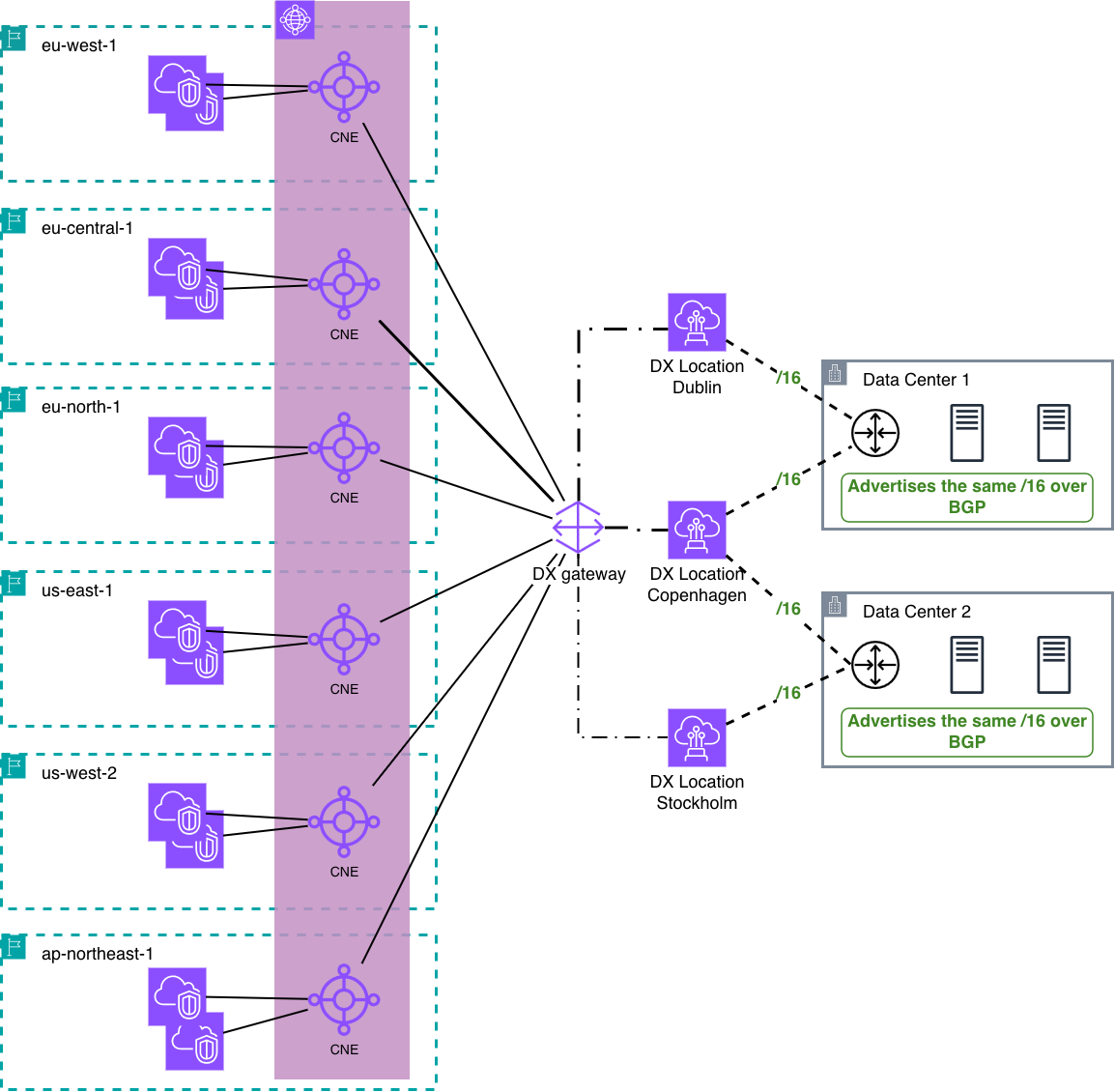
DeepL’s infrastructure is intentionally distributed to deliver high availability and ultra-low latency for its real-time translation workloads. The company deploys workloads across six distinct AWS Regions: three in Europe (Ireland [eu-west-1], Frankfurt [eu-central-1], and Stockholm [eu-north-1]), two in the United States (us-east-1 and us-west-2), and one in the Asia-Pacific region (Tokyo [ap-northeast-1]). Each Region encompasses multiple virtual private clouds (VPCs) and distinct AWS accounts.
On premises, DeepL anchors its physical operations in two major European data centers. These facilities are interconnected via a highly resilient Multiprotocol Label Switching (MPLS) network utilizing dedicated, high-capacity fiber optics between the sites. In a standard steady-state operational mode, the network avoids complex, extraneous traffic engineering. Instead, it relies on AWS’s default closest-exit egress behavior.
Under this default policy, outbound traffic from AWS leaves through the Direct Connect location closest to its geographic origin. For instance, data originating in the Ireland Region exits via Dublin, Frankfurt traffic exits through Copenhagen, and Stockholm traffic utilizes its local gateway. This localized routing paradigm minimizes latency and reduces configuration overhead, ensuring optimal performance for end-users relying on DeepL’s instantaneous AI translation tools.
The Operational Challenge of Single-Link Maintenance
For enterprises managing large-scale, multi-Region hybrid networks, performing routine maintenance on a physical router or transport circuit at a specific Direct Connect location is an inevitable requirement. However, taking a single AWS Direct Connect link out of service demands extreme precision.
In DeepL’s deployment, the core operational objective during a maintenance window was to safely drain traffic away from one specific Direct Connect location—such as Dublin—while allowing every other AWS Region to continue utilizing its local exit uninterrupted. Achieving this requires a thorough understanding of where egress decisions are formulated within a multi-Region cloud network integrated with AWS Cloud WAN.
Anatomy of BGP Path Selection: Direct Connect Gateway versus Core Network Edge
Before modifying BGP attributes, network architects must evaluate the distinct layers where path selection occurs. When Direct Connect is attached to an AWS Cloud WAN core network, routing decisions are partitioned between the Direct Connect gateway and the core network edge.
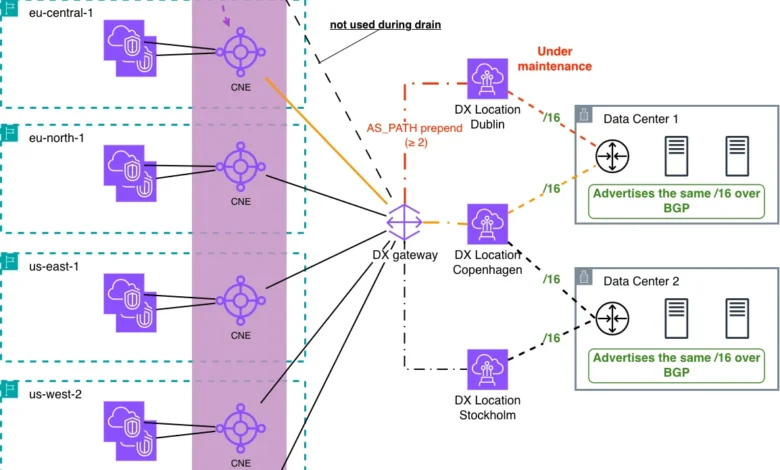
At the Direct Connect gateway level, path selection for prefixes reachable through multiple locations relies on BGP local preference. AWS assigns a medium local preference community to Direct Connect locations associated with the originating Region, and lower values to remote locations. Crucially, local preference is evaluated before the AS_PATH attribute in the BGP best-path selection algorithm. Because local preference applies a uniform ranking across all Regions served by the gateway, altering local preference for a specific prefix would inadvertently shift the egress paths for every Region simultaneously. Consequently, DeepL avoided using local preference modifications for single-link maintenance, as doing so would compromise the closest-exit behavior for unaffected Regions.
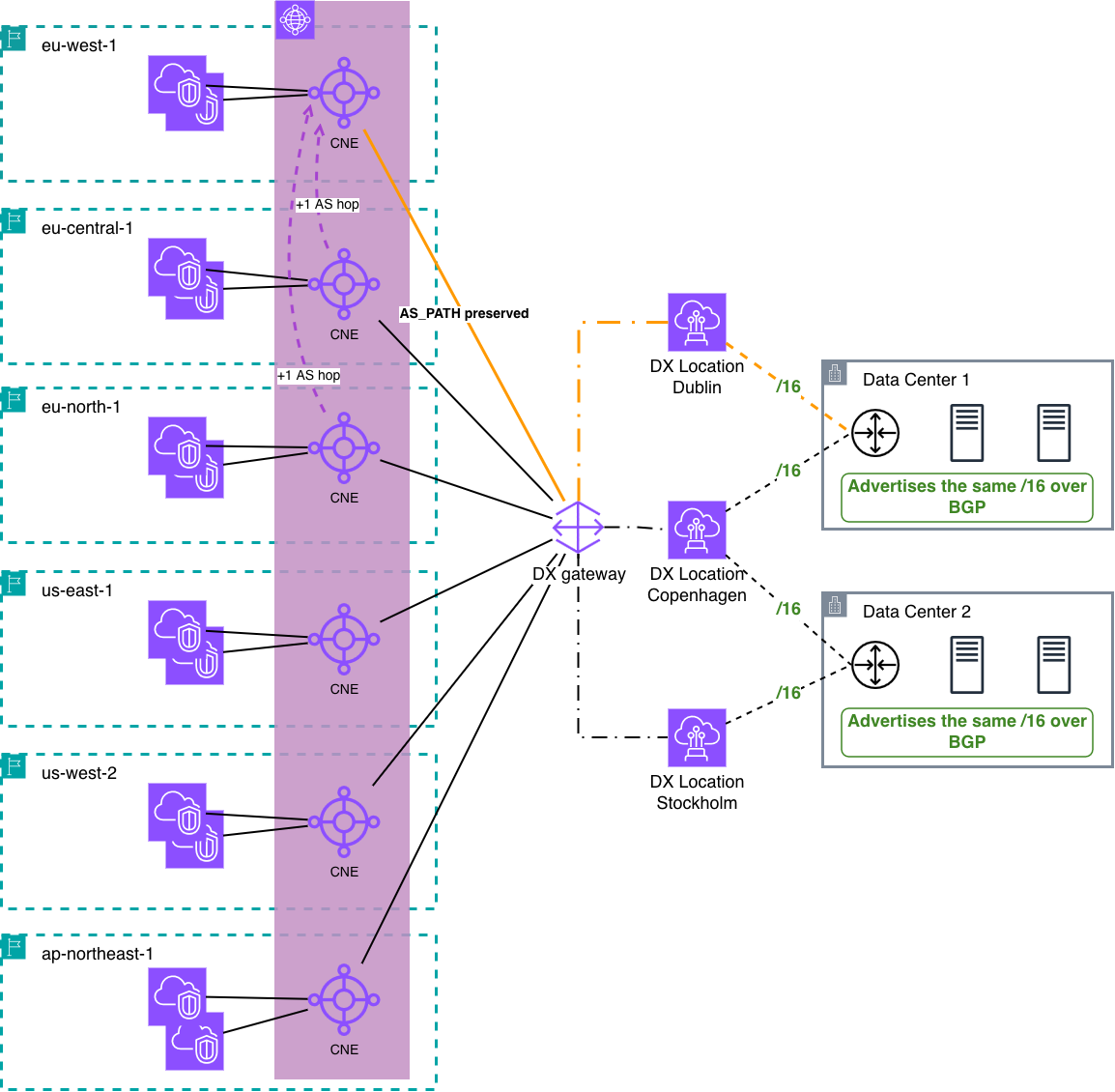
Conversely, path selection at the core network edge offers the necessary granularity. Each core network edge receives on-premises paths from the Direct Connect gateway while preserving the original AS_PATH. Simultaneously, the edge learns the same prefix from peer edges across the core network, where each peer adds its own Autonomous System Number (ASN), making those alternative paths one hop longer. Because the core network edge evaluates AS_PATH length prior to other tie-breakers, it natively prefers the direct path through its local Direct Connect gateway.
Execution of the Maintenance Drain Using AS_PATH Prepending
To isolate and drain a single link—such as the Dublin connection—without disrupting global operations, DeepL implements an on-premises AS_PATH prepend on the targeted virtual interface.
By prepending additional AS numbers to the advertised prefix from the local data center routers, the Dublin path is artificially made less preferable specifically to the eu-west-1 core network edge. This triggers two immediate network adjustments:
- The eu-west-1 core network edge identifies the Dublin path as longer due to the added AS hops.
- The edge automatically shifts its egress traffic to an alternative healthy location, such as Copenhagen or Stockholm, while all other European and global Regions continue routing through their respective local exits.
Importantly, all BGP sessions remain active throughout the maintenance procedure. Because routes are not abruptly withdrawn, DeepL successfully circumvents the convergence gaps and packet loss typically associated with traditional route withdrawal methods. Traffic migrates smoothly before the targeted link is taken out of service.
Strategic Considerations and Trade-Offs for Cloud Architects
While AS_PATH prepending provides a powerful mechanism for targeted traffic engineering, cloud platform teams must account for specific operational trade-offs before adopting this architecture.
During a link drain, cross-Region data transfer dynamics change. Traffic originating from eu-west-1 that is diverted to an alternate Direct Connect location in a different country or city may incur additional inter-Region data transfer costs and a minor, acceptable increase in propagation latency while the local link is offline. Furthermore, network engineers must validate that redundant circuits possess sufficient spare capacity to absorb the temporary influx of shifted traffic from the drained Region without experiencing congestion.
Future Outlook: Adoption of AWS Cloud WAN Routing Policies
Looking ahead, DeepL plans to expand its network automation capabilities by integrating AWS Cloud WAN routing policies. While the current maintenance drain relies on native path selection and manual BGP adjustments, Cloud WAN routing policies introduce priority-ordered rule sets that offer explicit programmatic control over route propagation and attribute manipulation within the core network.
DeepL intends to leverage these routing policies to automate fallback location selection during maintenance events and to streamline route summarization across its global hybrid footprint. This evolution highlights a broader industry trend toward intent-based networking in multi-cloud environments.
Industry Implications and Expert Recommendations
The architectural strategy deployed by DeepL illustrates the maturing best practices for managing enterprise-grade hybrid cloud infrastructure at scale. As organizations increasingly migrate latency-sensitive AI and machine learning workloads to multi-Region cloud architectures, maintaining predictable network performance during routine infrastructure maintenance becomes a critical differentiator.
Network architects and cloud platform engineers operating distributed hybrid networks are advised to review native AWS documentation regarding Direct Connect gateway attachments in Cloud WAN, global hybrid connectivity patterns, and BGP community behaviors. Rigorous simulation and validation of traffic drains in isolated non-production environments remain essential prerequisites before deploying similar strategies into active production pipelines. Through careful planning and precise BGP engineering, enterprises can achieve high availability, seamless maintenance cycles, and uninterrupted user experiences across the globe.